Google’s AI Overviews, and now AI Mode, are reshaping how people find information online, and if you run a small business, you’ve probably noticed some changes in your website traffic. This is an evolution rather than a catastrophe. Businesses that understand what’s happening and make smart adjustments will continue to thrive.
What Are AI Overviews?
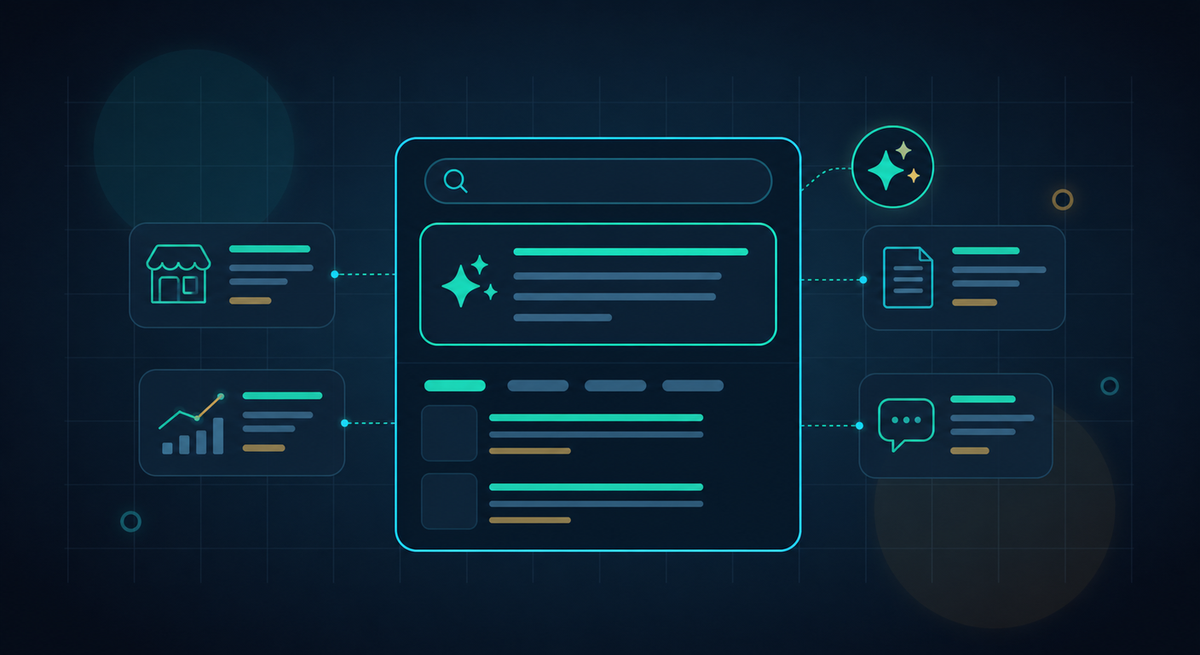
AI Overviews are AI-generated summaries that Google displays at the very top of search results, above the traditional blue links. They pull together information from multiple sources and present a synthesised answer directly on the results page.
Rolled out globally in 2024, AI Overviews are now available in more than 200 countries and are seen by over one billion users every month. When they appear, they look like a boxed summary with a short answer and a set of source links on the side, which gives users a quick answer without necessarily clicking through to any individual website.
At a high level, Google’s AI reads and synthesises content from across the web, then generates a response it believes best answers the query. The sources it draws from are cited, which means your content can appear there even if you’re not ranking in position one.
AI Overviews and AI Mode: What’s the Difference?
You’ll hear these two terms used almost interchangeably, but they describe different things, and it’s worth knowing which is which before you decide what to do about either.
AI Overviews are the summaries described above: an AI-written answer sitting at the top of an otherwise normal results page, with the traditional blue links still underneath. AI Mode is a separate, fully conversational search experience. You ask a question, read the answer, then ask a follow-up, much like a chat. There is no page of ten blue links to scroll through. Instead you get a conversation, with sources cited alongside the response.
AI Mode has grown fast. It has now passed one billion monthly users, and the number of queries running through it has more than doubled every quarter since launch. The practical implication for a small business is straightforward. Some of your customers are still scanning a results page, and a steadily growing number are having a conversation with Google instead. You need to be findable in both.
The search box itself has changed
Google has also rebuilt its Search box, the largest redesign in more than 25 years. It is now AI-powered and built to accept much richer input: full sentences, detailed descriptions, images, and follow-up questions, rather than the two or three keywords people have been trained to type since the late nineties.
That changes what people actually search for. Instead of “emergency plumber Bristol”, someone might now type “my boiler is leaking and I need somebody who can come out this evening in south Bristol”. A page written to match a short head term doesn’t really answer that. A page that addresses the specific, real-world situation, with the detail a worried customer actually needs, does.
The Real Impact on Traffic
It is worth being honest about the numbers. Studies have found that AI Overviews reduce click-through rates on affected queries by approximately 31%. That’s a meaningful drop, and it’s concentrated on informational searches, the kind where someone is looking for an explanation, a definition, or a how-to answer.
However, context matters:
- Not every search query triggers an AI Overview. Google is selective about when they appear.
- Transactional searches (“buy running shoes near me”) and navigational searches (“Acme Plumbing contact”) are far less affected.
- If your business depends on local or purchase-intent traffic, the impact is likely smaller than the headlines suggest.
The shift is real, but it’s targeted. Understanding which searches are affected is the key to responding effectively.
It’s also worth being realistic about the direction of travel. As AI answers take on more of the explaining, purely informational pages will earn fewer clicks, and that trend is unlikely to reverse. The searches that still send people to a real business are the commercial ones: someone who needs a quote, a booking, a visit, or a product in their hands. That is where your attention, and your strongest pages, belong.
Warning
Which Searches Trigger AI Overviews?
AI Overviews appear most often for informational and how-to queries, searches where someone wants to learn something rather than do or buy something.
Most affected query types:
- “How does X work?”
- “What is the difference between A and B?”
- “Best ways to [accomplish a task]”
- “Why does [thing] happen?”
Much less affected:
- Local searches: “plumber in Bristol”, “coffee shop near me”
- Transactional searches: “buy [product]”, “[service] pricing”
- Branded searches: “[Your Business Name] opening hours”
This is genuinely good news for local businesses. If your customers are searching for a service in their area, or looking to make a purchase, AI Overviews are unlikely to intercept that traffic. Your Google Business Profile and local SEO remain as important as ever.
How to Get Your Content Cited in AI Overviews
Here’s where the opportunity lies. Google’s AI cites its sources in both AI Overviews and AI Mode, and your content can be one of them. Being cited builds brand visibility even when users don’t click through, and it still drives clicks from people who want the full story.
Info
Here’s how to optimise for citation:
Write structured, direct answers. AI Overviews favour content that answers a specific question clearly and early. Lead with the answer, then provide supporting detail. Use clear H2 and H3 headings so Google can identify what each section covers.
Add FAQ sections. A well-structured FAQ at the bottom of a page is one of the most effective ways to get cited. Each question should have a concise, self-contained answer of two to four sentences.
Implement schema markup. Structured data helps Google understand your content. FAQ Schema and HowTo Schema are particularly relevant for AI Overview citations. These are snippets of code added to your page that label your content in a machine-readable way. Your web developer or a plugin like Yoast SEO can handle this.
Build strong E-E-A-T signals. E-E-A-T stands for Experience, Expertise, Authoritativeness, and Trustworthiness, Google’s framework for evaluating content quality. Practical ways to demonstrate E-E-A-T include:
- Author bios that highlight real credentials and experience
- Original data, case studies, or first-hand examples
- Citations and links to reputable sources
- A clear “About” page and transparent contact information
Include specific, extractable details. Vague copy is difficult for an AI to quote. Name the towns and postcodes you cover, explain how your pricing works (even a typical range or a “from” figure helps), and set out your process step by step. Lead times, qualifications, opening hours, and what happens after someone gets in touch are exactly the kind of concrete details that get pulled into an answer.
Keep your information current. AI systems lean towards pages that look recently maintained and accurate. Old prices, services you no longer offer, or a number nobody answers frustrate customers, and they also make a page less likely to be surfaced in the first place.
What Hasn’t Changed
Amid all the noise about AI, it’s worth stepping back and recognising what remains constant.
Relevance, trust, and authority still drive both traditional search rankings and AI Overview citations. Google’s AI is trained to surface content that is genuinely helpful, accurate, and credible. That means the fundamentals of good SEO (writing clearly, earning backlinks, building a trustworthy site) still apply, and they matter more now than they did before.
Thin content, keyword stuffing, and low-quality pages are less likely to be cited by AI and less likely to rank well in traditional results. The bar for quality has risen, but the direction of travel is the same. Be genuinely useful to your audience.
Your Practical Checklist
Use this checklist to audit your content and make targeted improvements:
Tip
- Answer specific questions directly. For each page or post, identify the core question it answers and make sure that answer appears clearly near the top.
- Use clear H2 and H3 structure. Break your content into labelled sections so both readers and Google can navigate it easily.
- Add FAQ sections. Identify the three to five questions your customers most commonly ask about each topic and answer them concisely on the relevant page.
- Implement schema markup. Add FAQ Schema to FAQ sections and HowTo Schema to step-by-step guides. Use a plugin or ask your developer.
- Build genuine expertise signals. Add author bios to blog posts, publish original research or case studies, and make your credentials visible.
- Keep content fresh. Review and update key pages regularly. AI Overviews favour current, accurate information.
- Double down on local SEO. Keep your Google Business Profile complete and up to date. Encourage genuine customer reviews.
- Add the specific details people ask for. Service areas, pricing context, lead times, and a plain step-by-step of how you work. Concrete facts get quoted; generic copy doesn’t.
- Prioritise commercial-intent pages. Make your service, pricing, and contact pages the strongest on the site, because those are the searches that still bring people to your door.
- Write for conversational queries. Think about the full questions customers ask in person, and answer those on the page in the same words they would use.
Adapt, Don’t Panic
AI Overviews are a significant change to the search landscape, but they’re not the end of organic traffic for small businesses. The businesses that will struggle are those that relied on thin, generic content to rank. The businesses that will thrive are those that focus on genuine helpfulness. That means answering real questions, demonstrating real expertise, and building real trust with their audience.
It helps to be clear-eyed about where the effort pays off. Informational posts are now doing a slightly different job, building credibility and getting your name into AI answers, while your service, pricing, and contact pages carry the commercial load. Write for both, but judge them by different measures.
That’s always been the goal of good SEO. AI Overviews and AI Mode simply make it more important to get right. Start with the checklist above, make incremental improvements, and keep your focus on serving your customers well. The fundamentals haven’t changed, and neither has the opportunity.
When I take on this kind of work, I start by structuring pages so the answers are easy to extract, then make the commercial pages the strongest on the site. Send the project brief with your current traffic picture and the searches you want to win.