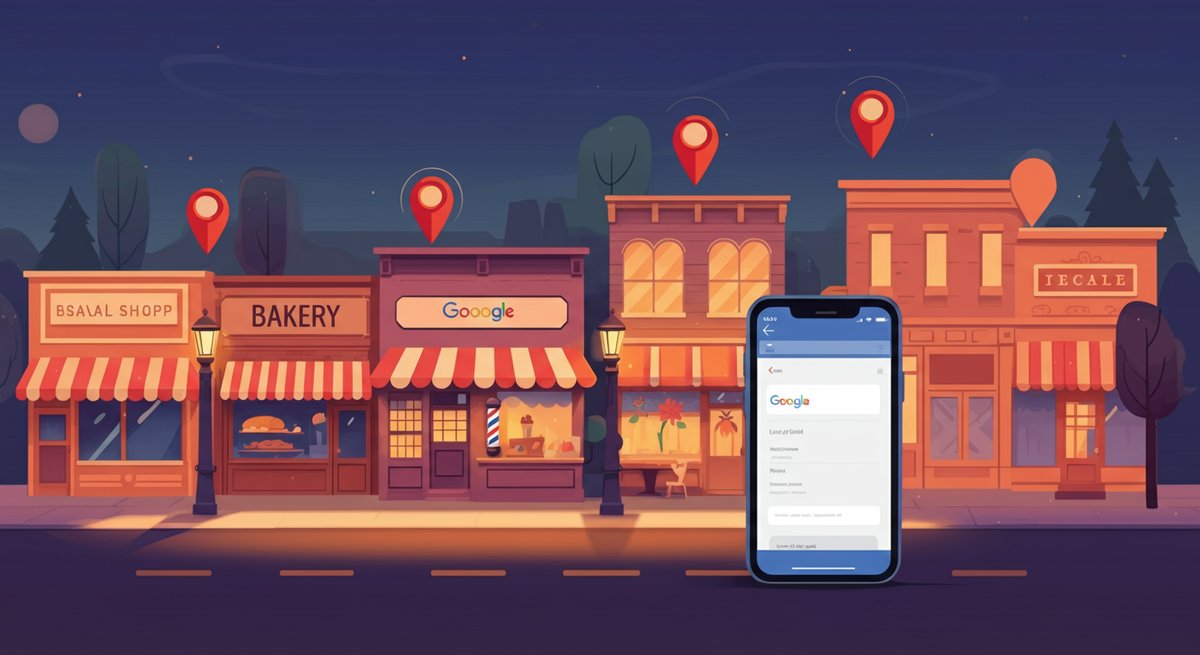
When someone nearby searches for "best coffee shop near me" or "plumber in [your city]," local SEO determines whether your business appears or gets buried. In 2026, the stakes are even higher: AI Overviews now surface in roughly 43% of local search queries, and 27% of all US searches end without a single click to a website. For small businesses, local search remains one of the highest-return marketing channels available, but the rules have changed.
What Is Local SEO?
Local SEO (Search Engine Optimization) is the practice of optimizing your online presence so that your business appears prominently in location-based search results. This includes the Google Map Pack (the three local listings that appear at the top of many searches), organic results with local intent, voice search queries like "open now near me," and increasingly, AI-generated answer panels that summarize local options directly on the results page.
Local SEO differs from traditional SEO in a few key ways. It relies heavily on proximity signals, your Google Business Profile, and the consistency of your business information across the web. With focused effort, small businesses can still outrank large national chains in local results, and they can now appear in AI-generated summaries that millions of searchers see every day.
AI Overviews & Zero-Click Visibility
As of 2026, Google's AI Overviews appear in approximately 43% of local search queries. These AI-generated panels pull together business information, reviews, hours, and location data to answer searchers' questions directly on the results page, often before they ever visit a website. This is the new reality of zero-click search.
The primary data source Google uses to populate these AI-generated local results is your Google Business Profile. A complete, accurate, and regularly updated GBP drives both your Map Pack ranking and the AI-generated answers that reach searchers who may never click through to your site.
Practically, this means you need to optimize for zero-click visibility as well as website traffic. A searcher who sees your business name, hours, phone number, and five-star rating in an AI Overview and then calls you directly is a real conversion, even though they never visited your website. Measuring success in local SEO now means tracking calls, direction requests, and messages alongside traditional click-through rates.
Tip
Optimizing Your Google Business Profile
Your Google Business Profile (GBP) is the single most important asset in local SEO. It powers your appearance in Google Maps, the local pack, and AI Overviews. Claiming and fully optimizing it is non-negotiable, and after the March 2026 Google core update, it matters more than ever.
Warning
Here's what a fully optimized GBP looks like:
- Business name, address, and phone number (NAP) that exactly match your website
- Accurate business category (primary and secondary)
- Complete business hours, including holiday hours, kept current at all times
- A keyword-rich business description (up to 750 characters) written in clear, factual language
- High-quality photos of your storefront, interior, team, and products
- Regular Google Posts to share offers, events, and updates (at least weekly for best results post-March 2026 update)
- Products or services listed with descriptions and pricing
Google rewards completeness and activity. Profiles that are regularly updated with posts, photos, and Q&A responses rank higher than stale, incomplete listings, and they are far more likely to be featured in AI Overviews.
Zero-Click Conversions: Rethinking What "Success" Looks Like
Approximately 27% of US searches now end without a click to any website. For local businesses, that shift changes where conversions happen rather than removing them. When a potential customer finds your phone number in the Map Pack and calls you, that's a conversion. When they tap "Get Directions" from your GBP listing, that's a conversion. When they send you a message through Google, that's a conversion.
Small business owners who measure local SEO success only by website traffic are missing a large portion of the value their GBP generates. Google Business Profile Insights tracks calls, direction requests, website clicks, and messages separately. Use these metrics to get a complete picture of your local search performance.
Zero-Click Conversions to Track
- Phone calls initiated directly from your GBP listing or AI Overview
- Direction requests, a strong indicator of in-person visit intent
- Messages sent through Google Business Profile
- Booking or appointment clicks made directly from the Map Pack
Info
Local Citations and NAP Consistency
A local citation is any online mention of your business's Name, Address, and Phone number, collectively known as NAP. Citations appear on directories like Yelp, Yellow Pages, TripAdvisor, and industry-specific platforms. They serve as trust signals: the more consistently your NAP appears across the web, the more confident Google is that your business is legitimate, and the more reliably your information will be surfaced in AI-generated results.
Why NAP Consistency Matters
Even small discrepancies ("St." vs. "Street," a missing suite number, or an old phone number) can confuse search engines and erode your local ranking. After the March 2026 core update, NAP consistency has become an even stronger signal. Audit your existing citations using tools like BrightLocal or Moz Local, and correct any inconsistencies you find.
Where to Build Citations
- Core directories: Google Business Profile, Apple Maps, Bing Places, Facebook
- General directories: Yelp, Yellow Pages, Foursquare, Angi
- Industry-specific directories: Houzz (home services), Healthgrades (medical), Avvo (legal)
- Local directories: your city's Chamber of Commerce, local news sites, neighborhood blogs
Getting and Managing Customer Reviews
According to BrightLocal's 2026 Local Consumer Review Survey, 97% of consumers read reviews for local businesses before making a decision. Reviews are one of the ranking factors Google weighs most heavily for local results, and they now serve a dual purpose: influencing human readers and feeding AI search systems that use review sentiment and volume as trust signals when generating local recommendations.
When Google's AI Overviews summarize local businesses, review ratings and recent review content are among the primary inputs. A business with a strong, recent review profile is more likely to be featured positively in AI-generated answers. Earning reviews builds social proof for human visitors and the data signal that AI systems rely on to recommend your business.
How to Earn More Reviews
- Ask at the right moment, right after a successful service or purchase, when satisfaction is highest
- Make it easy by sharing a direct link to your Google review page via text, email, or a QR code at your counter
- Train your team so that asking for reviews is a natural part of the customer experience
- Follow up with a polite post-visit email or SMS reminder, which can significantly increase review volume
Just as important, respond to every review, positive or negative. Thoughtful responses show prospective customers that you care, and they give you another opportunity to naturally include local keywords. They also demonstrate to AI systems that your business is actively engaged with its customers.
Building a Local Keyword Strategy
Local keywords combine what people are searching for with where they're searching from. The formula is service plus location. Think "emergency electrician Austin TX" or "organic bakery Brooklyn." But effective local keyword strategy goes deeper than just appending a city name, and in 2026 it also means thinking about how AI systems interpret and surface your content.
Types of Local Keywords to Target
- Geo-modified keywords: "[service] in [city]" or "[service] near [neighborhood]"
- "Near me" keywords: these are resolved by Google based on the searcher's location
- Landmark-based keywords: "dentist near [local landmark or district]"
- Service-area keywords: if you serve multiple towns, create dedicated pages for each
Use tools like Google Keyword Planner, Semrush, or Ahrefs to research search volume and competition for your target keywords. Focus on terms with clear local intent and realistic ranking potential for a new or growing site.
On-Page Local SEO Tips
Your website is the foundation of your local SEO strategy. Even the best Google Business Profile won't compensate for a website that fails to communicate your location and services clearly to search engines, and to the AI systems that increasingly pull from on-page content to generate local answers.
Key On-Page Optimizations
- Include your city and service in the page title tag and H1 heading
- Embed a Google Map on your contact page
- Add LocalBusiness schema markup (structured data) to help Google understand your NAP, hours, and service area. Structured data is also a key input for AI-generated local results
- Place your NAP in the footer of every page, and make sure it matches your GBP exactly
- Create location-specific landing pages if you serve multiple areas
- Write locally relevant blog content covering community events, local guides, or neighborhood-specific tips
- Ensure your site is mobile-friendly and loads quickly, because most local searches happen on mobile devices
Putting It All Together
Local SEO in 2026 is an ongoing practice rather than a one-time project, and it now spans traditional search, AI Overviews, and zero-click conversions. Start with the fundamentals: claim and optimize your Google Business Profile, audit your citations for consistency, and make sure your website clearly communicates who you are and where you operate. Then layer in review generation, local content, and keyword-targeted pages over time.
The businesses that win locally are the most visible, the most trusted, and the most relevant to their community, not necessarily the biggest. With 97% of consumers reading reviews, AI Overviews reshaping how results are displayed, and zero-click conversions becoming a primary measure of local search value, consistent effort across all these channels is what separates thriving local businesses from invisible ones.
Local visibility comes down to getting small details right across your profile, your citations, and your own site, and that is the kind of detail work I do. Send the project brief with your service areas and current listings, and I will tell you where the gaps are.